The Love Triangle (三角恋)

FOR MATURE READERS ONLY.  Sang is a young scholar living alone in a small village in 18th century China. One night a strange and beautiful woman arrives at his house, and he soon falls deeply in love with her.  But later, a second even more beautiful woman arrives, and things become extremely complicated.  This is a story about fox spirits and ghosts, love and lust, and the unpredictable nature of the human and the not-quite-human…
Continue reading »

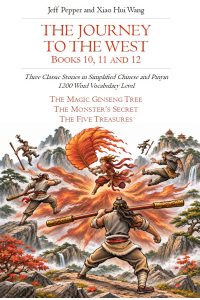
The Journey to the West, Books 10, 11 and 12

This book is a compilation of books 10, 11 and 12 in our Journey to the West series of story books for people learning to read Chinese.  The three stories told here – The Magic Ginseng Tree, The Monster’s Secret, and The Five Treasures – are unchanged from our original versions except for minor editing and reformatting. In the Magic Ginseng Tree, Tangseng and his disciples arrive at a secluded mountain monastery which turns out to be the home of a…

Continue reading »

The Journey Begins (西遊開始) in Traditional Chinese

The young monk Xuanzang sets out on his westward journey. His journey is difficult and filled with dangers. He runs into trouble immediately when he is captured and nearly killed by the Monster King and his ogres. He escapes with the help of a mysterious old man, only to be attacked on the road later by tigers, snakes and more monsters. Eventually he meets the Monkey King, Sun Wukong. Together they face bandits and wild…

Continue reading »

The Emperor in Hell (獄裡的皇帝) in Traditional Chinese

This story starts innocently enough, with two good friends chatting as they walk home after eating and drinking at a local inn.  One of the men, a fisherman, tells his friend about a fortune-teller who advises him on where to find fish.  This seemingly harmless conversation between two minor characters triggers a series of events that eventually cost the life of a supposedly immortal being, and cause the great Tang Emperor himself to be dragged…

Continue reading »

The Young Monk (小和尚) in Traditional Chinese

In this book we tell the story of the monk Xuanzang’s birth and early years. Our story begins with the Buddha’s decision to bring his wisdom to China. Then we meet Xuanzang’s father and mother and learn about their terrible ordeals around the time of his birth. Finally we jump ahead to when Xuanzang turns eighteen, learns of his true parentage, and avenges his parents. This is the 4th book in the best-selling The Journey…

Continue reading »

Ye Xian, the Chinese Cinderella Story (叶限)

The story of Cinderella is possibly the most widespread and popular of all folk tales.  The earliest known version is from Greece around two thousand years ago, and over the next thousand years, it traveled to France, Italy and Germany, and eventually to the Walt Disney studio in America. But as the Cinderella story traveled from Greece to Western Europe, it was also carried eastward to Asia along the Silk Road and other ancient trade…

Continue reading »

Hulin and the Mad Goose (虎林和狂鹅)

Folk tales are immensely popular in China.  Passed down orally over the centuries from grandparents and parents to children, they serve as an unwritten handbook for living.  Nearly all Chinese folk tales are about simple people who find themselves in difficult situations.  These people are often helped (and occasionally hindered) by talking animals, as well as by powerful gods, wizards and other supernatural beings who actively interfere in events here on earth (天下, tiānxià, “under…

Continue reading »

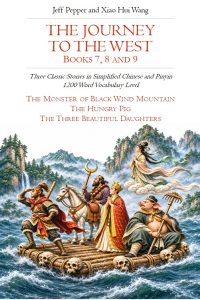
The Journey to the West, Books 7, 8 and 9

This book is a compilation of books 7, 8 and 9 in our Journey to the West series of story books for people learning to read Chinese.The three stories told here – The Monster of Black Wind Mountain, The Hungry Pig, and The Three Beautiful Daughters – are unchanged from our original versions except for minor editing and reformatting. In The Monster of Black Wind Mountain, we tell the story of the first few months of the journey…

Continue reading »

San Zi Jing (三字经)

Welcome to 三字经, San Zi Jing, known in English as the Three Character Classic. The San Zi Jing was written by Wang Yinglin during the Song Dynasty in the 13th century, modified many times since then, and memorized by generations of Chinese students. It’s a box of treasures, a puzzle within a puzzle, with layers of meaning waiting you to discover. At the simplest level, San Zi Jing is just a workbook, a way for…

Continue reading »

The Immortal Peaches (仙桃) in Traditional Chinese

Once again the Monkey King’s unlimited ambitions and uncontrolled appetites land him in deep trouble. He is given a job in heaven taking care of the Emperor’s Garden of Immortal Peaches, but he can’t stop himself from eating all the peaches. He impersonates a great Immortal and crashes a party in Heaven, stealing the guests’ food and drink and barely escaping to his loyal troop of monkeys back on Earth. And in the end, he…

Continue reading »